Lesson 6: Complex Intersections & Critical Situations
Mastering complex intersections: blind junctions, bending priority roads, multi-lane roundabouts, green turn arrows, and railway crossings.
1.1 Obstructed Exits & Junctions: Working with the Sightline
Parked vehicles often obstruct the view to the left. Here the examiner expects no risky blind rolling, but controlled caution:
- Use sightlines: Pause at the exit so the parked vehicle acts as a view marker: creep out inch by inch until you gain a clear line of sight through the parked cars into the street.
- Maintain waiting position: As long as visibility is obstructed, remain fully behind the junction line without poking into the carriageway. Accelerate out smoothly only when clear — never blind-crawl into moving traffic.
- At standard T-junctions as well: if you cannot see both directions simultaneously, take the time for two distinct checks — look left first, then right.
1.2 Bending Priority Roads & Hidden Priority Rules
- Sign 306 with bend: The priority road curves off — right of way follows the course of the road (Sign 306), not the straight path. Without examiner instruction, you must indicate and follow the priority curve; vehicles on the straight road have no priority over you.

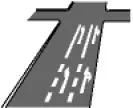
- Sign 205 (Give way): Make it obvious you have assessed the intersection — readiness to brake, look left and right, and enter promptly once clear.
- Examiner tip (practical tip): If you go straight when the priority road bends, you leave the priority road without right of way — often causing illegal priority failure. Remember: Right of way = follow the thick line on the sign.
1.3 Multi-Lane Roundabouts
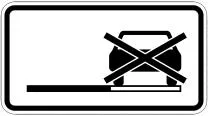
- Choose your lane before entering: First exit → right lane; more than halfway round → left (inner) lane; indicating left when entering multi-lane roundabouts outside built-up areas (inside cities: road markings govern; the general rule of thumb "single lane use in cities, two-lane permissible outside" — practical tip; Annex 2 to Sign 215 regulates direction of travel, center island, and parking prohibitions).
- When exiting from the inner lane: Signal right, right shoulder check, if needed in two stages (first merge to outer lane, then exit) — never cut across from the inner lane directly over the cycle lane.
- Cyclists around intersections: Bike paths run parallel to roundabouts — when exiting, perform a right shoulder check and maintain at least 1.5 m side clearance in urban areas (StVO § 5 (4)).
- Hatched restricted areas (Sperrflächen): Do not drive over them — driving on them is prohibited (Sign 298 StVO).
- Examiner tip (practical tip): At a two-lane exit, announce your intended exit early out loud (think aloud: "taking second exit, staying inside until the exit marking") — hesitating here blocks circulating traffic.
1.4 Traffic Light Intersections: Green Arrows, Cyclists & Green Waves
- Green metal arrow plate (StVO § 37 (2) No. 1): Turning right on red permitted only after a complete stop — exactly like a STOP sign: cyclists and pedestrians with green have absolute right of way; then creep to the sightline and turn only when totally clear.
- Turning right on green light: Even with green: interior mirror → right exterior mirror → turn signal → right shoulder check — cyclists proceeding straight ahead cross with the green signal.
- Green wave (Grüne Welle): On coordinated light corridors, pace your driving with the green sequence instead of having to brake hard at the next signal — steady cruising demonstrates anticipatory driving.

- Pedestrians at traffic lights: When turning, give way to crossing pedestrians on zebra crossings, even if your vehicle traffic light is green.
1.5 Railway Level Crossings (StVO § 19)
- St. Andrew's Cross (Sign 201) is the warning signal: reduce speed, give priority to rail vehicles, and stop if necessary.
- Poor visibility conditions: Cross the tracks only after stopping — standard exam procedure; StVO § 19 (2) governs duties to wait (train approaching, flashing lights, barriers) — stop, check both track directions, then cross promptly without stopping on the tracks. Stopping at half distance to the cross if sight is blocked is a reliable practical tip.
- Shunting operations: Pay close attention to light signals during shunting (red or white signals, flashing lights) — if signals are unclear: stop and wait (practical tip; StVO § 19 governs waiting duties at flashing and signal lights).

- Never stop on the tracks: Before crossing, verify there is sufficient space beyond the crossing — avoid getting stuck on the tracks in traffic jams; if traffic ahead is stopped, wait in front of the St. Andrew's Cross.

- Examiner tip (practical tip): At blind crossings without barriers, the examiner expects an obvious, complete stop — simply coasting slowly while dragging the brake does not suffice.
1.6 Trams, Bus Lanes & Oncoming Traffic While Overtaking
- Designated bus lanes (Sign 245, StVO Annex 2): Generally prohibited for other vehicles (exceptions only via additional signs). Trams must be allowed to proceed unhindered wherever possible (StVO § 2 (3)).
- Oncoming traffic when overtaking outside built-up areas: Before overtaking, verify that the oncoming lane has sufficient clear distance. Headlight flashing (Lichthupe) from oncoming traffic is a hazard warning (StVO § 16) — take it as a command to abort overtaking and pull back into the right lane immediately.
- Sudden pedestrians & children: In residential areas, near schools, and where Sign 136 (Children) is posted — mandatory syllabus item per FahrschAusbO Annex 3 No. 12.6 — drop your speed before any danger becomes visible; explain your slower speed aloud if you drive below ambient traffic flow.
1.7 Managing Exam Panic & Nervousness
- Slow down your driving pace, not your decisions: When feeling nervous, consciously drive at slightly lower speeds with larger safety margins — this is fully permissible and safe as long as you do not obstruct other traffic.
- Mentally close the door on mistakes: Marking is based on repeated or accumulated errors (FeV Annex 7 No. 2.5.2 b) — a single isolated mistake does not fail you. After any mistake: take a deep breath and start the next driving task completely afresh.
- Speaking aloud helps: State your traffic observations aloud (see Lesson 9) — this calms your nerves and shows the examiner your thought process.
Practical Tips
- At every blind junction follow this order: Stop → secure your view → hold position → act promptly once visibility is completely clear.
- Priority does not mean rushing: even on a priority road keep brake readiness — driving to "win" rather than "check" leads to failure.
- In roundabouts, choose your lane before entering and state it aloud — never switch lanes inside the roundabout if avoidable.
Useful Phrases (German)
- „Kann ich bitte hier stehen bleiben, bis ich die Kreuzung vollständig überblicken kann?“ (May I please wait here until I have a full view of the intersection?)
- „Ich halte an, weil die Sicht auf die Schienen nicht frei ist.“ (I am stopping because the view of the railway tracks is obstructed.)