Lesson 4: City Driving Test — Avoiding Common Traps
City traffic pitfalls: priority rules, buses at bus stops, stop signs and green turn arrows, lowered curbs, and cyclist protection according to StVO.
1.1 Core Driving Scenarios (StVO & FahrschAusbO)
- Speed limits: Maximum 50 km/h (StVO § 3), in Zone 30 as posted, in traffic-calmed zones (play streets) walking speed 4–7 km/h — the StVO (Annex 3, Sign 325.1) specifies only "walking speed"; 4–7 km/h is the practical rule of thumb.
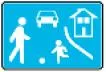
- Intersections: Traffic light intersections, sign-regulated intersections, and uncontrolled intersections with "Priority to the Right" (Rechts vor Links); readiness to brake and active observation are mandatory syllabus items (FahrschAusbO Annex 3 No. 11, including roundabouts No. 11.8).
- Roundabout: When entering do not signal, give way to circulating traffic and pedestrians at crossings; stay in lane until your exit; when exiting must signal right and watch for pedestrians and cyclists crossing the exit road.
1.2 💡 City Driving Traps & Standard Reactions
- Trap 1 — "Silent instructions" from the examiner (practical tip): Fundamental exam rule: "If I say nothing, continue straight ahead or follow the course of the priority road."
- Priority road bending off (Sign 306 with supplementary turn arrow): The examiner remains silent — you must indicate and follow the bending priority road on your own.


- Sign 267 (No entry) or "Residents only" (Anlieger frei) ahead: The examiner will not warn you. You must spot the sign yourself and actively indicate and turn legally — or ask: "Straight ahead is prohibited; should I turn left or right?" Driving straight into a forbidden street ends the test instantly.
- Trap 2 — Public transit buses & school buses at stops (StVO § 20):
- Bus with right indicator / without hazard flashers: Careful overtaking is permitted — always anticipate passengers walking out from in front of the bus.
- Bus with hazard warning flashers on: While approaching the bus stop → overtaking strictly prohibited (StVO § 20 (3)); once stopped at the curb → pass only at walking speed (rule of thumb: 4–7 km/h), and this applies to oncoming traffic as well (unless roadways are structurally separated — StVO § 20 (4)).

- Bus signals left to pull out: Stop and allow the bus to depart from the stop (StVO § 20 (5)). Practical tip: give ample space and avoid squeezing past.
- Trap 3 — STOP sign (Sign 206) & Green turn arrow plate (StVO § 37 (2) No. 1):
- Sign 206 (STOP): All wheels must come to a complete standstill (0 km/h), practical rule: pause for at least 2–3 seconds at the stop line (practical tip; the law requires stopping before entering the intersection). If visibility is blocked from the stop line: after 3 seconds, crawl forward to the sightline and stop a second time to verify before proceeding.
- Green arrow sign (Grüner Blechpfeil) beside a red traffic light (turning right): treated exactly like a STOP sign — stop fully at the stop line (StVO § 37 (2) No. 1) → let pedestrians and cyclists with green light pass → move up to the sightline → turn right only when traffic is completely clear.
- Trap 4 — Lowered curb (StVO § 10): When exiting properties, parking areas, or traffic-calmed zones over a lowered curb, "Priority to the Right" does not apply — you must yield to all directions; pedestrians have absolute priority.
- Trap 5 — 30 km/h zones & reflexes at equal intersections: At every "Priority to the Right" intersection: foot off accelerator and onto brake pedal (readiness to brake) — the examiner feels this footwork before the car decelerates — and turn your head deep into the street to your right. Never force right of way, but never forfeit it without cause.
- Trap 6 — Protecting cyclists (StVO § 5 (4)): When overtaking cyclists or e-scooters in urban areas, keep at least 1.5 m side clearance. If road width is insufficient → stay patiently behind the cyclist.
- When turning right: Interior mirror → right exterior mirror → right turn signal → right shoulder check, to check for cyclists proceeding straight in the right lane/bike path.